Selenite Corp Contracts
Selenite Corp offers contracts — structured objectives with guaranteed rewards. Complete contracts to unlock access, earn resources, and advance your standing. But higher tiers come with hidden costs.
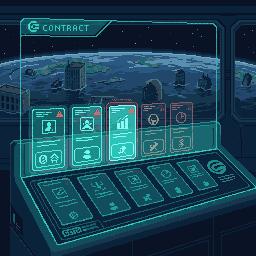
Contract Benefits
What Contracts Provide
- Access to restricted zones — Some areas require clearance
- Premium telepad access — Better fees, more reliable extraction
- Better-paying jobs — Higher tier = higher rewards
- Experimental equipment — Corp-exclusive technology
- Information — Intel on surface conditions, opportunities
Contract Tiers
Clearance Levels
| Tier | Requirements | Rewards | Hidden Costs |
|---|---|---|---|
| Basic | None (starting level) | Modest resources, basic gear | None apparent |
| Standard | Complete basic contracts | Better pay, zone access | Corp surveillance increases |
| Advanced | Reputation + resources | Premium access, good equipment | Morally questionable objectives |
| Elite | High standing + special tasks | Best rewards, restricted tech | Deep complicity, increased danger |
Contract Types
Cargo Transport (Primary Work)
The backbone of Moonstalker economy — transporting cargo between fabrication depots using Corp-owned vehicles:
- Accept contract at depot terminal
- Fabricate vehicle using nanotech systems (Corp property, not yours)
- Load cargo at origin depot
- Deliver cargo to destination depot
- Return vehicle to any depot (flexible)
Payment based on:
- Cargo value and distance
- Delivery speed (time bonuses)
- Vehicle condition (pristine = bonus, damage = reduced pay, loss = you pay)
You're not paid for vehicle rental. You're paid for cargo delivery. The vehicle is a tool, and you're liable for its condition.
See Vehicle Cargo Missions for detailed mechanics.
Other Contract Types
- Retrieval
- Recover specific items from designated locations. Straightforward but can require travel through dangerous zones.
- Survey
- Scan or document specific areas. Information gathering for Corp purposes.
- Maintenance
- Repair or activate Corp infrastructure. You're doing their work for them.
- Clearance
- Remove threats from areas of Corp interest. Wildlife, unstable structures, or... other obstacles.
- Delivery
- Transport items between locations. What's in the package? Better not to ask.
Cargo Transport Mission Details
Mission Variables
Cargo contracts vary significantly across multiple dimensions:
- Cargo Value
- Low-value materials (construction supplies, bulk salvage) vs. high-value goods (processed resources, Corp equipment, sensitive materials). Higher value means better pay but increased liability if lost.
- Distance & Route
- Short hauls between nearby depots vs. long-distance cross-region transport. Distance affects time pressure, flood exposure, and fuel/power requirements.
- Vehicle Type
- Different contracts require different vehicles (ground transport, amphibious, heavy cargo, fast courier). Vehicle choice affects route options and flood vulnerability.
- Route Hazards
- Some routes are well-traveled and relatively safe. Others cross dangerous zones (wildlife territory, unstable structures, radiation zones, hostile Drifter areas).
- Time Constraints
- Urgent deliveries pay bonuses for speed but risk forcing you to push through floods or hazards. Standard contracts allow flexible timing.
- Multi-Point Routes
- Some missions require pickups or deliveries at multiple locations, creating complex route planning.
Vehicle Damage Economics
The condition of the vehicle when returned directly affects your payment:
| Condition | Payment Modifier | Description |
|---|---|---|
| Pristine | +10-15% bonus | No damage. Careful driving rewarded. |
| Good | Full payment | Minor wear, expected condition. |
| Damaged | -20-40% penalty | Significant damage but functional. You pay for repairs. |
| Heavily Damaged | -50-70% penalty | Barely functional. Major repairs required. |
| Total Loss | Full vehicle cost | Vehicle destroyed or abandoned. You're liable for replacement. |
The Tension: Push through hazards for speed bonuses vs. take safe routes to preserve vehicle condition. The faster you go, the more damage you risk. The safer you play, the less you earn.
Chaining Contracts
Experienced Moonstalkers maximize earnings by chaining multiple cargo missions:
- Route optimization — Accept contracts that create efficient multi-stop routes
- Backhaul opportunities — After delivery, check destination depot for return contracts
- Vehicle familiarity — Keeping the same vehicle across multiple missions lets you learn its handling
- Cumulative damage risk — Each mission adds wear, making vehicle abandonment decisions harder
The choice to return a vehicle or continue working creates constant economic tension. Every additional mission increases earnings but also increases damage liability. When do you stop?
The Hidden Costs
What They Don't Tell You
As you rise through contract tiers, things change:
- Surveillance increases — Corp knows where you go, what you find
- Contracts become morally questionable — "Clearance" might mean people
- Evidence contradicts narratives — You start finding things that don't match Corp's story
- Digging too deep gets dangerous — Questions lead to harder, deadlier contracts
The Weyland-Yutani Problem
Selenite Corp's contracts pay well, but you're working for the corporation that:
- Likely caused the cataclysm
- Controls the teleportation network you depend on
- Treats Moonstalkers as disposable resources
- Is hiding something about what really happened to the moon
Higher tier contracts = better rewards = deeper complicity.
Group Contracts
Coordinated Objectives
Some contracts require or benefit from multiple Moonstalkers:
- Reactivating facilities (multiple simultaneous activations)
- Clearing large threats (overwhelming for a single operator)
- Transporting heavy equipment (requires multiple carriers)
- Complex surveys (cover more ground in limited time)
Group contracts often pay better per-person, incentivizing cooperation.