Core Gameplay Mechanics
The core gameplay of MOONSTALKERS centers on a tension between risk and reward. Every mechanic reinforces the central question: how much are you willing to risk for how much potential gain?
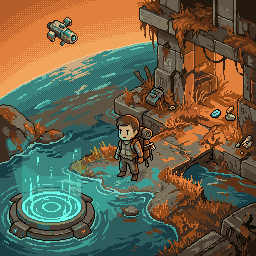
The Core Loop
The Cycle
- Wake up in your vessel. Check tide forecast. Check depot status and cargo contracts. Check your last save state. Gear up from secured inventory.
- Teleport to fabrication depot. Select depot based on contract availability and operational status. Materialize on telepad inside Corp facility. Accept cargo transport mission.
- Fabricate vehicle. Watch nanotech systems build your transport. Load cargo. The vehicle is Corp property — your job is delivery.
- Work. Transport cargo between depots. Gather resources. Complete contracts. Explore ruins. Encounter other Moonstalkers. Help or be helped.
- Survive floods. Shelter in underground hatches or inside your vehicle. Share space with other players. Emerge when the water recedes. Manage vehicle damage.
- Decide: stay or extract? Do you have enough resources to pay the teleportation fee? Is there more to gather? Should you return the vehicle or chain another contract? How much are you risking by staying? How long since your last save?
- Extract or die. Return vehicle to any depot. Reach a teleportation pad, pay the fee, secure your progress. OR: push too far, die, wake up in your clone bay having lost everything since your last extraction.
- Progress. Extracted resources become permanent. Mission payments secured. Upgrade your vessel. Unlock new capabilities. Prepare for the next teleportation. Save your current state.
- Repeat. Each cycle builds on the last. Each risk weighs against potential reward. Each extraction is relief. Each death is loss.
Saved vs. At-Risk
The Key Distinction
The psychological heart of MOONSTALKERS is the distinction between progress that's saved (secured in your vessel) and progress that's at-risk (on your person on the surface).
| Status | Your Stuff | If You Die | If You Logout |
|---|---|---|---|
| Just dropped | Loadout gear (from vessel) | Lose it all, respawn from last save | Character remains on surface, vulnerable |
| Gathering on surface | Loadout + gathered loot | Lose everything, respawn from last save | Character remains on surface, vulnerable |
| Survived a flood in hatch | Still holding everything | Still lose it if you die later | Character remains on surface, vulnerable |
| Extracted to vessel | Everything secured | Respawn from THIS point with gear intact | Safe — progress is saved |
Surviving floods lets you accumulate more before extracting. But the longer you stay, the more you're risking. That tension — "do I extract now or push for one more cycle?" — is the core gameplay loop.
Spawn: Teleportation to Surface
First-Time Spawn
New players wake up in their Clone Bay with fragmented memories — a side effect of resurrection technology. A brief tutorial establishes the basics: tide mechanics, Selenite Corp's "employment" structure, how teleportation works, and fabrication depots. Your vessel AI (damaged, glitchy, but functional) guides you through your first teleportation to the surface.
Regular Spawn (Returning Players)
You wake in your vessel's Command Deck. You check:
- Tide forecast — When's the next flood? Which zones are accessible?
- Depot status — Which fabrication depots are operational?
- Cargo contracts — What missions are available? Which routes pay best?
- Inventory status — What gear survived your last extraction?
- Clone save state — How much progress is locked in?
Then you gear up from your personal locker (equipped with items you've previously extracted and saved) and choose which fabrication depot to teleport to.
Teleportation to Surface
You teleport to a fabrication depot — Selenite Corp's nanotech hubs scattered across the surface. You select a depot from the map (considering current tide levels, contract availability, and operational status). The teleportation is instantaneous but unsettling — organic matter only, molecular reconstruction.
Why Organic Matter Only
Selenite's teleportation network can only safely transport organic material. The energy cost scales exponentially with mass and molecular complexity. A human body (70kg of water and carbon) is manageable. A multi-ton vehicle with thousands of manufactured components would require prohibitive energy — more than an entire depot's daily output.
This limitation shapes the entire economy: people teleport up and down, but vehicles, cargo, and heavy equipment must be fabricated on-site using nanotech or transported manually.
Spawn is "free" (from your perspective) because Selenite Corp subsidizes inbound teleportation as part of their labor infrastructure. They pay to get workers to the surface. You pay to extract yourself back to your vessel with whatever you've gathered.
Once you're down, the only ways back up are:
- Selenite Teleportation Pad at a depot (costs resources — YOU pay for extraction)
- Death (respawn in your vessel, lose everything)
Depot Selection Interface
- Operational status — Which depots are currently online?
- Cargo contracts — What vehicle missions are available from this depot?
- Resource opportunities — Nearby high-value zones
- Hazard warnings — Wildlife activity, unstable structures, radiation levels
- Tide predictions — When will this depot area flood?
- Activity indicators — Heat maps showing where other Moonstalkers are working
- Telepad congestion — High traffic increases extraction fees later
You materialize on a teleportation pad inside the fabrication depot — a bustling Selenite Corp facility with automated security, vehicle fabrication bays, cargo staging areas, and other Moonstalkers arriving and departing.
Surface Survival
Riding Out Floods (Temporary Safety)
When a flood approaches, you can shelter in Underground Hatches.
What hatches are:
- Abandoned Selenite infrastructure, pre-collapse bunkers, or hastily dug survival shelters
- Scattered across the map, some obvious, some hidden
- Varying conditions: some intact, some damaged, some barely functional
- Shared spaces — other Moonstalkers can use the same hatch
What sheltering gives you:
- You survive the flood
- You keep everything on your person
- You stay on the surface for the next low-tide window
- BUT: Nothing is "banked" — if you die before extracting, you lose what you gathered
Why you'd shelter instead of extract:
- You don't have enough resources to pay the teleportation fee yet
- You're mid-contract and not done
- You've found a lucrative area and want to keep working it
- The nearest teleportation pad is too far or too dangerous to reach
- Extraction pads are currently offline (tide interference, technical failure)
The risk:
- Your progress isn't saved. Death means losing everything since your last vessel save.
- Other Moonstalkers might be in the same hatch (potential for cooperation or tension)
- Hatches can fail — structural damage, flooding, equipment malfunction
- You can't safely log out
Death and Respawn
The Clone Bay System
Your vessel contains a Clone Bay with your genetic backup and memory imprint technology. It's Selenite Corp tech, widely distributed before the collapse (possibly for reasons beyond simple convenience).
How it works:
- When you extract to your vessel, your current state is saved — inventory, experience, memories
- If you die on the surface, you respawn in your vessel from your last save point
- Everything you gathered after that save is lost
- Your body remains on the surface briefly, but there's no one to loot it — it simply degrades
The psychological cost:
- Each death means losing all progress since your last extraction
- You wake up with memory discontinuity — you remember dropping, but not what killed you
- Your vessel AI can sometimes piece together what happened from recovered data fragments
- Frequent deaths cause clone degradation — minor glitches, personality drift, unsettling déjà vu
The strategic layer:
- How long do you risk staying on the surface before saving?
- Is it worth pushing for one more high-value resource, or extracting now to secure what you have?
- If you die, how much real-time progress did you just lose?
Vehicle Cargo Missions
The Primary Work
The backbone of surface economy is cargo transport — moving valuable materials between fabrication depots using Corp-owned vehicles. This is the main source of reliable income for Moonstalkers.
You don't own the vehicle. You're responsible for delivering cargo and returning it in reasonable condition. Vehicle damage comes out of your pay.
Mission Flow
- Accept Contract: Review available cargo missions at your arrival depot's terminal. Each contract specifies pickup location, delivery depot, cargo type, base payment, and time constraints.
- Fabricate Vehicle: At the vehicle bay, the depot's nanotech systems fabricate your assigned transport. The process takes minutes — molecular assembly building the vehicle from stored material templates. You watch it materialize: frame, hull panels, power systems, cargo bed.
- Load Cargo: Automated systems or manual loading (depending on cargo type). Containers are sealed and registered to your mission ID. You're responsible for delivery.
- Transport: Drive/pilot the vehicle to the destination depot. Navigate flooded terrain, avoid hazards, manage fuel/power, survive tidal cycles. The vehicle is your mobile shelter — it can withstand floods, but damage accumulates.
- Deliver Cargo: Arrive at destination depot, confirm delivery, unload cargo. Payment is processed based on cargo condition, delivery time, and vehicle condition.
- Return Vehicle: You DON'T have to return the vehicle immediately. You can:
- Accept another mission from the destination depot (chain contracts)
- Drive to a different depot with better opportunities
- Abandon the vehicle and teleport out (costs you the vehicle deposit)
- Keep using it as mobile shelter during floods
- Eventually return it to ANY fabrication depot when you're done
- Settlement: When you finally return a vehicle to any depot, Corp systems assess its condition. Pristine condition earns a bonus. Damage reduces your payment. Severe damage means you pay for repairs. Total loss means you're liable for replacement cost.
Why Vehicles Work This Way
Nanotech fabrication makes vehicles cheap for Selenite Corp to produce. The molecular templates are reusable, and damaged vehicles are simply disassembled back into raw feedstock and re-fabricated. It's more economical than teleporting vehicles (which would cost more than the vehicle's worth).
This creates the mission structure: Corp provides vehicles freely but expects them back in reasonable condition. You get paid for cargo delivery, not vehicle rental. The vehicle is a tool, not a reward.
Risk Decisions
- Do you push through rising floodwaters to make the delivery deadline, risking vehicle damage?
- Do you shelter in place and miss the time bonus?
- Do you take the direct route (faster, more dangerous) or the safe route (slower, protected)?
- Do you chain multiple contracts to maximize efficiency, or return the vehicle quickly to avoid accumulating damage?
- Do you abandon a heavily damaged vehicle and teleport out, or try to limp it back to avoid the liability cost?